Leadership Retreat Venues: A Practical Guide for Senior Teams
The venue for a leadership retreat is not a neutral container. The right setting — exclusive, residential, appropriately scaled — makes a measurable difference to what comes out of the programme. This guide covers what to look for, what it costs, and where to find it in 2026.
What makes a leadership retreat different from a standard offsite?
A conference hotel with a breakout room and a team dinner is a standard corporate event. A leadership retreat is designed to shift how a senior team thinks together — not simply to inform them. The setting shapes the thinking. Before evaluating venues, it is worth being precise about what makes this category genuinely distinct.
🎯
Smaller & more senior
Typically 6–20 people: the board, exec team, senior leadership group. Psychological safety and candour matter more than logistics or room capacity.
🏡
Residential depth
Usually two or three nights. Structured working sessions combined with unstructured time where the real conversations happen. Both phases need proper spaces.
🔒
Non-negotiable confidentiality
When the CEO and CFO are discussing the next 18 months of strategy, they cannot be overheard by other hotel guests. Exclusive use is the single most important criterion.
🌿
Environment as ingredient
A room with natural light and bookshelves makes a different kind of conversation than fluorescent lights and hotel carpet. The setting is an active part of the programme.
Evaluation Framework
What to look for — eight criteria specific to senior teams
01
Exclusive use
The entire property for your group only. Non-negotiable for board retreats and CEO forums. Verify the terms: some venues offer "exclusive use of meeting rooms" while other guests occupy bedrooms — which is not exclusive use in the sense that matters.
02
Single-occupancy bedrooms for all
Shared rooms do not work for a board meeting. Every senior leader needs their own room with a private bathroom. Clarify this before pricing: a venue advertising "10 bedrooms" may mean five doubles.
03
Working space that doesn't feel like a meeting room
Natural light first. A table large enough for the full group second. Then: bookshelves rather than whiteboards, an interesting view, surfaces that are not covered in corporate-neutral carpet tiles.
04
At least one breakout space
Small-group work and paired conversations need somewhere separate from the main room. A kitchen table, a study, a covered garden area. It does not need to be formal — it needs to exist.
05
Grounds or outdoor space
Morning walks, informal outdoor conversations, an evening firepit. These are not optional extras — they are part of the programme architecture. Venues without meaningful external space constrain what a facilitator can do.
06
Catering that doesn't interrupt
Shared mealtimes create the rhythm that makes evening conversations possible. A private chef on-site or a catering partner who can deliver all meals without requiring the group to leave the venue or share dining with other guests.
07
Facilitation infrastructure
Can the venue support a visiting facilitator? Is there a projector or large screen, a decent flip chart, reliable Wi-Fi? Can a guest speaker arrive on-site? Many properties marketed as "retreat venues" cannot answer these questions clearly.
08
Right-sized for the group
Over-sized venues hollow out the retreat dynamic. A group of 10 rattling around a 30-bedroom manor loses the intimacy that makes leadership retreats work. Match venue capacity to group size, not the other way round.
Planning Decisions
Full-service operator vs venue hire only
Every buyer of a leadership retreat faces this decision. The framing matters: it is not a question of which option is cheaper. It is a question of planning capacity, programme complexity, and accountability for outcomes.
Venue hire only
Find and book the property yourself, bring your own facilitator or run sessions internally, arrange catering separately, and manage programme logistics in-house. This gives more control and typically a lower overall cost. The right choice for teams with an experienced internal programme lead, or organisations that have an established facilitator relationship and simply need a venue that will support the work.
Full-service operators
Companies such as Elsewhere Offsites or Campfire Company in the UK handle venue sourcing, facilitation, programme design, catering, and logistics under a single contract. The cost is significantly higher, but the planning burden is minimal and accountability for outcomes sits with the operator. This model suits first-time leadership retreats, time-pressured HR teams, and situations where programme complexity justifies professional management.
The hybrid approach
The most common for experienced buyers: book an appropriate venue independently, bring in an external facilitator with senior-team experience, and use the venue's own catering. This keeps costs lower than a full-service operator while ensuring the programme has proper professional facilitation. It requires more planning coordination, but it is manageable for any HR team that has done it once.
The question to ask is not "which is cheaper?" but "how much planning capacity do we have, and what level of programme quality do we need?" Neither model is inherently superior — the right answer depends on your team's experience and the stakes of the specific retreat.
Venue Options
UK & European Leadership Retreat Venues
A characterisation of the main setting types in the UK, followed by the strongest European options for UK teams.
UK setting types
Historic manor & country house (Cotswolds, Hertfordshire, Norfolk)
The default choice for senior leadership retreats in the UK, and often the right one. Prestigious, well-resourced, and typically 60–120 minutes from London. The challenge: many country houses are hotels first and retreat venues second — the infrastructure for facilitation (quality AV, good working tables, breakout rooms) is variable. West Lexham in Norfolk is a frequently cited example: whole-estate hire with a clear facilitation-friendly design philosophy. Thornycroft Hall in Cheshire and Riversdale Lodge in the Scottish Borders prioritise residential intimacy over hotel-scale capacity.
Properties designed specifically for immersive group work — less opulent than country houses, more intentional about programme architecture. 42 Acres in Somerset is a well-regarded example: a working farm with a deliberate philosophy around group immersion. Facilitation infrastructure tends to be stronger because the design started from the programme, not the property.
Remote & island venues (Osea Island, Essex)
Maximum separation from normal working life. The logistics of reaching Osea Island — accessible only at low tide — are deliberately inconvenient, which is the point. Genuine geographic separation produces a different quality of thinking. Suited to founder alignment retreats and leadership teams that need a complete break from normal context.
European Options for UK Teams
Exclusive-use properties in Latvia, Portugal, and Italy typically cost 30–50% less than comparable UK venues. Direct flights from London, Manchester, or Edinburgh run two to three hours. UK passport holders travel visa-free in the Schengen area for up to 90 days. The logistics are not significantly more complex than travelling to the Scottish Highlands.
⭐ Editor's Top Pick
🇱🇻 LatviaForest RetreatUp to 12 guests
Narbuli Retreat House, Latvia
📍 Amatciems, Central Latvia · 80 km from Riga International Airport
9.6
★★★★★
Exceptional · Top pick for intimate executive retreats
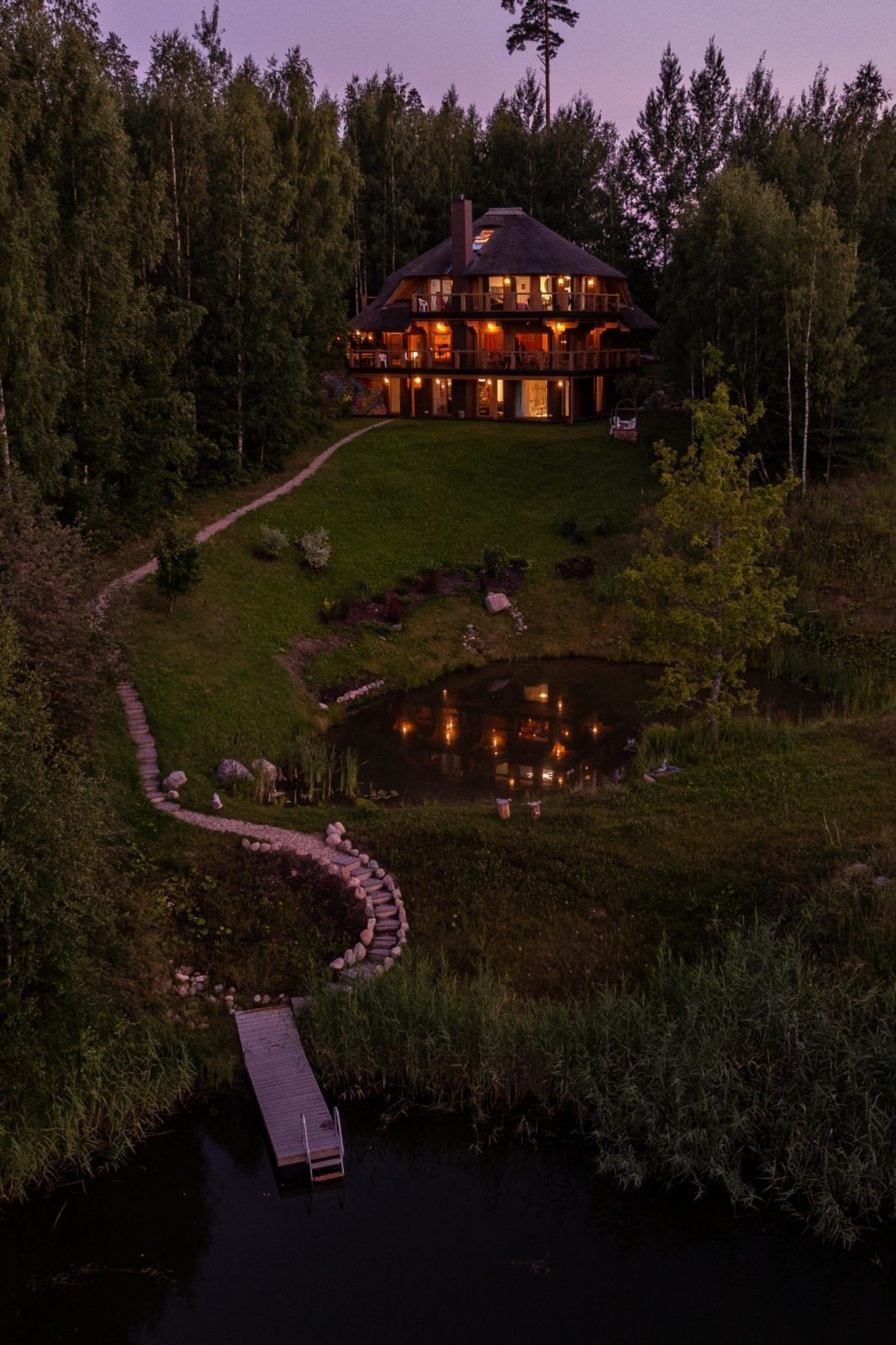
Narbuli Retreat House (retreatlatvia.com) is exclusive whole-property hire for groups of up to 12. Hillside forest setting — 52% of Latvia is forest, and the effect of that environment on the quality of sustained group work is real and measurable. The property uses an archetype room design that supports individual reflection between shared sessions: each room is built around a distinct psychological framework rather than a standard hotel aesthetic. On-site facilitation is available. This is not a conference hotel adapted for retreats — it is a house built with a deliberate design philosophy around group work.
9 archetypal private rooms (9–12 guests)
48 m² dedicated practice / meeting room
Traditional Finnish sauna
Two fully equipped kitchens
Lakeside terrace & fireplace lounge
Professional psychologist-coaches on site
Whole-property exclusive hire only
Hiking, cycling, kayaking nearby
"Nine rooms, nine archetypes, one extraordinary outcome — Narbuli is the retreat venue for leadership teams who want transformation alongside strategy. The forest setting and exclusive-use format ensure complete confidentiality and focus."
🇵🇹 PortugalWine Estate12–30 guests
Alentejo Estate Venues, Portugal
📍 Alentejo region · 2h 30m from London Heathrow to Lisbon
9.0
★★★★★
Excellent · Best for wellness-focused retreats & larger groups
Private wine estates in the Alentejo region offer outdoor meeting pavilions, full-board catering by estate kitchen teams, and capacity for 12–30. The environment — open plains, cork oak forests, long evening light — produces a quality of informal conversation that is difficult to engineer indoors. Suited to leadership teams or programmes that incorporate outdoor activities as part of the design.
Outdoor meeting pavilions
Estate kitchen full-board catering
Private wine cellar & tastings
Cork oak forest surroundings
Exclusive whole-estate hire
Yoga & wellness programming
🇮🇹 ItalyAlpine Farmhouse8–20 guests
South Tyrol Alpine Farmhouses, Italy
📍 South Tyrol region · 2h 20m from London to Florence or Innsbruck
8.8
★★★★★
Outstanding · Best for incentive & high-performance leadership programmes
Mountain environments with integrated spa facilities suit senior teams combining strategic planning with physical recovery — increasingly common for leadership programmes explicitly designed around high performance. The combination of altitude, physical activity, and structured evening sessions produces a distinct kind of programme intensity.
Mountain altitude environment
Integrated spa & wellness facilities
Exclusive private hire
Hiking & outdoor session spaces
In-house chef & alpine cuisine
Evening firepit & social spaces
Programme Design
Three programme design principles most guides miss
The working rhythm matters more than the agenda
The most effective leadership retreat programmes follow a recognisable daily structure: morning sessions for strategy and high-cognitive work (people are sharper and more candid before the social dynamics of the day settle in), afternoons for creative or outdoor sessions, evenings for informal conversation over shared meals. This rhythm works with the psychology of senior teams rather than against it. Implementing it requires a venue that supports each phase: a morning working room with natural light, outdoor grounds for afternoon activity, a dining room that facilitates conversation rather than ending it.
Unstructured time is not wasted time
The conversations that actually change how a leadership team works together rarely happen in facilitated sessions. They happen on a walk before breakfast, around a firepit, in the kitchen at midnight. Retreats that schedule every hour consistently produce lower-quality outcomes than programmes that deliberately leave space for this to occur. When evaluating a venue, the relevant question is not only "where will the sessions happen?" but "what happens between sessions?" A sitting room with comfortable chairs and a bottle of wine is a programme asset.
The facilitator's relationship with the venue matters
A facilitator who knows the venue will use the space better. They will know which room works for paired coaching, when to move the group outside, which outdoor space suits an afternoon reflective activity. If you are hiring venue and facilitator separately, a site visit or at minimum a detailed briefing call between them before the retreat is worth the planning time. A facilitator working blind in an unfamiliar venue will default to using the main room for everything — which wastes most of what a good venue offers.
At a Glance
Compare Venue Types
Quick-reference overview of the main leadership retreat venue categories covered in this guide.
Venue type
Location
Group size
Exclusive use
Meeting rooms
Wellness
From UK
Best for
Narbuli Retreat House
🇱🇻 Latvia
9–12
✓ Always
✓
✓✓
~2h 30m
Executive / leadership
Alentejo Estate
🇵🇹 Portugal
12–30
✓ Always
✓
✓✓
~2h 25m
Wellness / strategy
South Tyrol Alpine
🇮🇹 Italy
8–20
✓ Always
✓
✓✓
~2h 20m
High-performance / incentive
UK Country House
🇬🇧 UK
8–16
✓ (verify)
✓
—
1–2h drive
Senior leadership / board
Purpose-built Centre
🇬🇧 UK
8–20
✓ Always
✓✓
✓
1–2h drive
Leadership development
Remote / Island
🇬🇧 UK
8–20
✓ Always
—
—
2–3h
Founder alignment / strategy
Pricing Reference
How Much Does a Leadership Retreat Venue Cost?
Realistic 2026 figures based on the actual market for exclusive-use residential venues aimed at leadership teams. All prices in GBP, excluding facilitation unless noted.
Venue type
Group size
Duration
Venue hire (approx.)
All-in per head (incl. catering)
UK country house — exclusive use
8–16
2 nights
£4,000–£10,000
£500–£900 per head
UK purpose-built retreat centre
8–20
2 nights
£3,500–£8,000
£400–£800 per head
UK remote / tidal island
8–20
2 nights
£8,000–£20,000+
£1,000–£1,500+ per head
European estate (Latvia, Portugal, Italy)
6–12
2 nights
£2,500–£6,000 (excl. flights)
£450–£750 per head · flights add ~£150
Full-service operator (UK)
10–20
2 nights
£800–£1,500 per head all-in
Includes venue, facilitation, catering & activities
What drives cost variation: Group size is the most significant lever — exclusive-use venues have fixed costs, so smaller groups pay more per head. September–October and April–May are peak periods with higher pricing. A senior external facilitator adds £1,500–£4,000 per day. A mid-range retreat for 12 people, two nights, quality UK country house, and external facilitator for two days typically costs £700–£1,000 per head all-in — comparable to, or lower than, a conference hotel for the same group, with significantly higher programme quality.
Buyer's Guide
How to Choose a Leadership Retreat Venue
These six questions separate an average offsite from a retreat that produces genuine change in how a senior team works together.
01
Define the outcome, not the programme
What does this group need to do differently after the retreat? Start with that question, not with the agenda. It will determine whether you need a venue built for focused working sessions or one built for personal reflection and team connection — often they are different properties.
02
Confirm exclusive use — verify the terms
Ask specifically: "Will any other guests be on the property during our stay?" Some venues offer exclusive use of meeting rooms while other guests occupy bedrooms. That is not exclusive use in the sense that matters for senior leadership retreats.
03
Match venue size to group size
An oversized venue hollows out the retreat dynamic. Aim for a property where the group feels like it fills the space — not one where 10 people rattle around a manor built for 40. Intimacy of scale is part of what the programme requires.
04
Set a realistic per-head budget early
Factor in: venue hire, accommodation, all meals, transfers, facilitation (£1,500–£4,000/day), and flights if international. European options can deliver comparable or superior environments at 30–50% lower total cost than UK equivalents.
05
Visit (or do a thorough virtual walkthrough)
Venue websites consistently misrepresent working spaces. A property that appears "meeting-room ready" online may have a beautiful drawing room that is wholly impractical for facilitated sessions. A 30-minute virtual tour with venue staff is worth doing before shortlisting.
06
Brief the facilitator and the venue together
A facilitator who knows the venue will use the space better. Arrange a call between your external facilitator and the venue coordinator before the retreat. This one conversation consistently produces better programme outcomes than any amount of pre-retreat planning in isolation.
FAQ
Frequently Asked Questions
Everything HR Directors, COOs, and Founders need to know before booking a leadership retreat venue.
A leadership retreat venue is a property suited to residential offsites for senior leadership teams — typically 6–20 people. The key characteristics are exclusive use (no other guests on-site), single-occupancy accommodation for all attendees, working spaces with natural light, and grounds that support both formal sessions and informal conversation. The best venues are designed to enable the programme, not merely to accommodate it.
Conference venues are designed for capacity and logistics — large groups, multiple concurrent events, hotel-style service. Leadership retreat venues prioritise exclusivity, intimacy, and environment quality. The critical difference is exclusive use: at a leadership retreat venue, your group is the only one on the property, which makes candid strategic conversation possible in a way that a hotel conference wing cannot replicate. The physical environment is an active part of the programme, not a neutral container.
Exclusive-use UK country house venues for a group of 10–16 typically cost £4,000–£10,000 for venue hire over two nights, plus catering. All-in per head — accommodation and meals, but not facilitation — runs £500–£900. Full-service leadership retreat operators who include facilitation and programme design charge £800–£1,500 per head all-in. European options such as Latvia and Portugal typically cost 30–50% less for the venue itself, with flights adding approximately £150 per person from UK airports.
Most leadership retreats work best for groups of 8–16. Smaller groups of 6–8 work well for founder teams, boards, and executive committees where depth of conversation is the priority. Larger groups of 20–30 are possible but require a more structured programme and a venue with parallel spaces. Above 30, the dynamics shift significantly — it becomes a conference, not a retreat, and venue requirements change accordingly.
Yes, for senior leadership teams. Exclusive use means your group has the entire property to themselves — no other hotel guests, no shared facilities, no risk of being overheard. For a board strategy session or CEO forum, this is non-negotiable. Verify the terms carefully: some venues offer "exclusive use of the meeting rooms" while other guests occupy the bedrooms — which is not exclusive use in the sense that matters for leadership retreats.
For most leadership retreats, yes. A skilled facilitator keeps working sessions productive, manages group dynamics, and creates the conditions for candid conversation. Without facilitation, retreats tend to default to extended team meetings with better food. For leadership retreats specifically, look for a facilitator with direct experience of working with senior teams — the dynamics at board and exec level are meaningfully different from team-building programmes for junior staff.
The Cotswolds remains the most popular choice — prestigious, well-resourced, and 90 minutes from London. The Lake District suits retreats with an outdoor programme element and teams wanting more dramatic natural scenery. Somerset, particularly around the Mendips, has a concentration of purpose-built retreat centres with strong facilitation infrastructure. Scotland — Perthshire and Argyll — offers genuine remoteness for teams that need significant psychological distance from their normal operating environment.
For a tight senior team of 6–12 — a founder group, a board, a tight exec committee — the priority is exclusivity and environment quality over scale. Narbuli Retreat House in Latvia is an example of a European exclusive-use venue specifically suited to groups of this size: whole-property hire, archetype rooms designed to support individual reflection, on-site facilitation, and 2 hours 30 minutes from London to Riga. In the UK, West Lexham in Norfolk offers comparable exclusivity with a similar philosophy around residential immersion. The key principle: the venue should feel like a house, not a hotel.
Start Planning
Ready to find your perfect leadership retreat venue?
Our top recommendation for UK leadership teams is Narbuli Retreat House in Latvia — a genuinely unique exclusive-use experience, just 2.5 hours from London, with on-site facilitation and a design philosophy built around group work.
Editorial note: This article is produced independently. Narbuli Retreat House appears as the top recommendation because it achieves the highest combined score across the evaluated criteria — not because of any commercial arrangement. All flight times are approximate; verify current routes before booking. Venue capacities, pricing, and availability change seasonally — contact venues directly for current information.